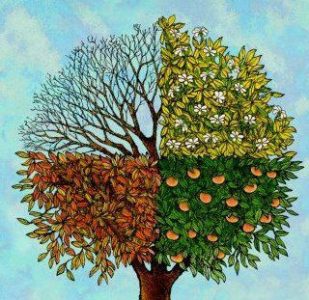
Basing itself on this deep and mysterious connection between the Source of
our individual lives and the source of the life of the planet, Druidry recognises
eight particular times during the yearly cycle which are significant and which
are marked by special observances.
Of the eight times, four are solar and four are lunar - creating thereby a balanced
scheme of interlocking masculine and feminine observances. The solar observances
are the ones that most people associate with modern-day Druids - particularly
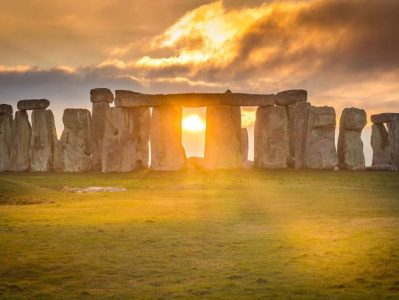
the Summer Solstice ceremonies at Stonehenge.
At the Solstices, the Sun is revered at the point of its apparent death at midwinter
- and of its maximum power at the noon of the year when the days are longest.
At the Equinoxes, day and night are balanced. At the Spring Equinox, the power
of the sun is on the increase, and we celebrate the time of sowing and of preparation
for the gifts of Summer. At the Autumnal Equinox, although day and night are
of equal duration, the power of the sun is on the wane, and we give thanks for
the gifts of the harvest and prepare for the darkness of Winter.
These four festivals are astronomical observances, and we can be sure our ancestors
marked them with ritual because many of the stone circles are oriented to their
points of sunrise or sunset. By the time the circles were built, our ancestors
had become a pastoral people, and times of sowing and reaping were vital to
them.
But as well as these four astronomical, solar festivals, there exist four times
in the year which were and are also considered sacred. These were the times
which were more associated with the livestock cycle, rather than the farming
cycle.
At Samhuinn, between October 31st and November 2nd, livestock for whom there
was insufficient fodder were slaughtered and their meat salted and stored. At
Imbolc, on February 2nd, the lambs were born. At Beltane, on May 1st, it was
the time of mating and of the passing of the livestock through the two Beltane
fires for purification. Lughnasadh, on August 1st, was the time which marked
the link between the agricultural and the livestock cycle - the harvest began
and both human food and animal fodder were reaped and stored.
The two sets of festivals represent far more than just times which our ancestors
chose to honour the plant and animal life-cycles though. They demonstrate our
thorough interconnectedness with both the animal and plant realms. It is only
modern-day people who can separate the life-cycles in an analytical way.
As we contemplate the festivals we shall see how interwoven is the life of our
psyche and of our body, of the planet and of the sun and moon - for each festival
time marks a potent conjunction of Time and Place in a way that is quite remarkable.
Lets look at the cycle now. The dates given are for the Northern hemisphere,
where they originated, but if you are in the Southern hemisphere, you need to
reverse the dates: so you would celebrate the Winter Solstice in June, the Summer
Solstice in December, and so on.
Looking at the complete cycle, we shall begin at Samhuinn - a time which marked
traditionally the ending and the beginning of the Celtic Year.
Samhuinn, from October 31st to November 2nd, was a time of no-time. Celtic society,
like all early societies, was highly structured and organised - everyone knew
their place. But to allow that order to be psychologically comfortable, the
Celts knew that there had to be a time when order and structure were abolished
- when chaos could reign. And Samhuinn was such a time. Time was abolished for
the three days of this festival, and people did crazy things - men dressed as
women and women as men. Farmers' gates were unhinged and left in ditches, peoples'
horses were moved to different fields, and children would knock on neighbours'
doors for food and treats in a way that we still find today, in a watered-down
way, in the custom of trick-or-treating on Hallowe'en.
But behind this apparent lunacy, lay a deeper meaning. The Druids knew that
these three days had a special quality about them. The veil between this world
and the World of the Ancestors was drawn aside on these nights, and for those
who were prepared, journeys could be made in safety to the 'other side'. The
Druid rites, therefore, were concerned with making contact with the spirits
of the departed, who were seen as sources of guidance and inspiration rather
than as sources of dread. The dark moon, the time when no moon can be seen in
the sky, was the phase of the moon which ruled this time, because it represents
a time in which our mortal sight needs to be obscured in order for us to see
into the other worlds.
The dead are honoured and feasted, not as the dead, but as the living spirits
of loved ones and of guardians who hold the root-wisdom of the tribe. With the
coming of Christianity, this festival was turned into Hallowe'en [October 31st]
All Hallows [November 1st] and All Saints [November 2nd]. Here we can see most
clearly the way in which Christianity built on the pagan foundations it found
rooted in these isles. Not only does the purpose of the festival match with
the earlier one, but even the unusual length of the festival is the same.
Next in the cycle is the time of the Winter Solstice, called in the Druid Tradition
Alban Arthan [the Light of Arthur]. This is the time of death and rebirth. The
sun appears to be abandoning us completely as the longest night comes to us.
Linking our own inner journey to the yearly cycle, the words of the Druid ceremony
ask "Cast away, O wo/man whatever impedes the appearance of light."
In darkness we throw on to the ground the scraps of material we have been carrying
that signify those things which have been holding us back, and one lamp is lit
from a flint and raised up on the Druid's crook in the East. The year is reborn
and a new cycle begins, which will reach its peak at the time of the Midsummer
Solstice, before returning again to the place of death-and-birth.
Although the Bible indicates that Jesus was born in the Spring, it is no accident
that the early Church chose to move his official birthday to the time of the
Midwinter Solstice - for it is indeed a time when the Light enters the darkness
of the World, and we see again the building of Christianity on the foundations
of earlier belief.
In a Christian culture we really only have one marker for the year, and that
is Christmas. Easter and Harvest-time used to be significant, but can hardly
be considered so now, when only a fraction of the British population attend
Church regularly.
Druidry has eight markers, which means that every six weeks or so, we have the
opportunity to step out of the humdrum of daily life, to honour the conjunction
of Place and Time.
The next Festival occurs on February 2nd, or the eve of February 1st. It is
called Imbolc in the Druid tradition, or sometimes Oimelc. Although we would
think of Imbolc as being in the midst of Winter, it represents in fact the first
of a trio of Spring celebrations, since it is the time of the first appearance
of the snowdrop, and of the melting of the snows and the clearing of the debris
of Winter. It is a time when we sense the first glimmer of Spring, and when
the lambs are born. In the Druid tradition it is a gentle, beautiful festival
in which the Mother Goddess is honoured with eight candles rising out of the
water at the centre of the ceremonial circle.
The Goddess that ruled Samhuinn was the Cailleach, the Grey Hag, the Mountain
Mother, the Dark Woman of Knowledge. But by Imbolc the Goddess has become Brighid,
the Goddess of poets, healers and midwives.
And so we often use Imbolc as a time for an Eisteddfod dedicated to poetry and
song praising the Goddess in her many forms. The Christian development of this
festival is Candlemas - the time of the Presentation of Christ in the Temple.
For years successive Popes had tried to stop parades of lit candles in the streets
of Rome at this time, until seeing that it was impossible to put a stop to this
pagan custom, they suggested that everyone enter the churches so that the priests
could bless the candles.
Time moves on, and in a short while we come to the Spring Equinox - the time
of equality of day and night, when the forces of the light are on the increase.
At the centre of the trio of Spring Festas, Alban Eilir [the Light of the Earth]
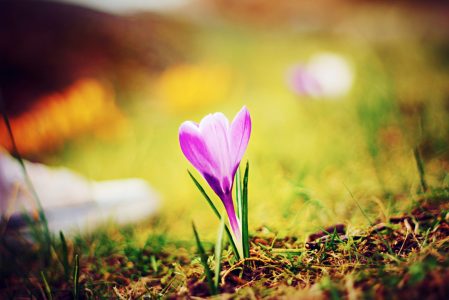
marks the more recognisable beginnings of Spring, when the flowers are beginning
to appear and when the sowing begins in earnest.
As the point of psychological development in our lives it marks the time of
late childhood to, say, 14 years - Imbolc marking the time of early childhood
[say to 7yrs].
We are in the Spring of our lives - the seeds that are planted in our childhood
time of Imbolc and Alban Eilir will flower from the Beltane time of adolescence
onwards as capacities and powers that will help us to negotiate our lives with
skill and accomplishment.
Beltane, on May 1st, marks the time of our adolescence and early wo/manhood.
Spring is in full bloom, and twin fires would be lit at this time, through which
would be passed the cattle after their long winter confinement, or over which
those hoping for a child or good fortune would jump.
We see traces of the Beltane celebrations on May Day, when dancing round the
maypole celebrates the fertility of the land and creates an echo of the ritual
circle dances that must have been enacted in stone circles throughout the country.
We have reached the time of the Summer Solstice, Alban
Hefin, The Light of the Shore, by June 21st or 22nd [the dates for each
of the solar festivals vary each year since the events are astronomical not
man-made, like our calendar]. Light is at its maximum, and this is the time
of the longest day. It is at this time that the Druids hold their most complex
ceremony. Starting at midnight on the eve of the Solstice, a vigil is held through
the night - seated around the Solstice fire. The night is over in a matter of
hours, and as light breaks, the Dawn Ceremony marks the time of the sun's rising
on this his most powerful day. At noon a further ceremony is held.
Six weeks later we come to the time of Lughnasadh on August 1st, which marks
the beginning of harvest time. The hay would have been gathered in, and the
time for reaping the wheat and barley was due. It was a time of gathering together,
of contests and games and of marriages. The marriages contracted at this time
could be annulled at the same time the following year - offering the couple
a sensible 'trial period'. In some areas a flaming wheel was sent rolling down
the hillside at this time to symbolise the descent of the year towards Winter,
and in the Druid ceremony a wheel is passed around the circle in symbol of the
turning year. The Christian version of this festival is Lammas, which has recently
been revived in some churches. The word Lammas comes from hlafmasse - 'loaf-mass'
- since bread is offered from the newly harvested grain.
The Autumnal Equinox, on September 21st or thereabouts, is called Alban Elfed or Light of the Water in the Druid tradition. It represents the second of the
harvest festivals - this time marking the end of harvest-time, just as Lughnasadh
marked its beginning. Again day and night are equally balanced as they were
at the time of the Spring Equinox, but soon the nights will grow longer than
the days and Winter will be with us. In the ceremony we give thanks for the
fruits of the earth and for the goodness of the Mother Goddess.
And so the circle completes itself as we come again to the time of Samhuinn - the time of death and of rebirth.
What does it mean to celebrate these festivals? Are we simply trying to revive
customs that belong to a different era, and are well forgotten? Those who follow
Druidry believe strongly that this is not the case. Just as Christmas and New
Year are vital to our psychic health because they give us some measure of the
passage of our lives, so -if we incorporate a celebration or recognition of
these times - do we find that we develop an increasing sense of peace and place
in our world and in our lives.
Let us look at the value of the festivals from a psychological point of view:
When we celebrate them we honour times which have been considered sacred for
over four thousand years. The four fire festivals relate to key life periods
and the experiences necessary for each one of them: Imbolc invokes the gentleness
and mothering that we need in our first years on earth. We need the stillness
of Imbolc, of the candles glittering on the water, of the Goddes Brighid who
sings to us each night as we fall asleep. When we have become young adults,
we need the initiation of Beltane - of Spring, when the force of our sexuality
courses through our blood and when we need the guidance of the tribe and its
mythos, not its denial or salaciousness.
As we become young adults at the Lughnasadh time of our lives and begin to build
a family, the rules change - the wildness of youth gives way to the constraints
that responsibility brings, and we need an understanding of this as part of
the wider scheme of things - not merely a 'knuckling down' to duty with the
seeds of rebellion in our hearts.
As we grow old, we approach the Gateway to the Other World. If we have followed
such a path as Druidry, this becomes a time of preparation for the Great Adventure,
a time in which we become familiar with our friends and guides in the Other
Worlds who show us, time and again, that death is really a birth to another
level - a wider horizon.
If we work with this scheme, we have a chance to invoke each of these phases
of our life every year - as if each year were a microcosm of our complete lives.
In the early Spring we open to the child who lives in each one of us - we honour
and acknowledge and cherish him, and we allow the healing breath of the Goddess
of Poetry to sing gently to him.
At Beltane, we open to the God & Goddess of Youth. However old we are, Spring
makes us feel young again, and at Beltane we jump over the fires of vitality
and youth and allow that vitality to enliven and heal us. When young we might
use this time as an opportunity to connect to our sensuality in a positive creative
way, and when older the mating that we seek might well be one of the feminine
and masculine sides of our nature. Integration of the animus and anima or of
the male and female aspects of the Self has long been seen as one of the prime
goals of spiritual and psychotherapeutic work, and Beltane represents the time
when we can open to this work fully - allowing the natural union of polarities
that occurs in nature at this time the opportunity to help us in our work -
a work that is essentially alchemical.
We move from conjunction to the fruits of that conjunction with the festival
time of Lughnasadh - the harvest being that of either children or of creative
works. This is a time of satisfaction in our accomplishments - whether that
means gazing into the face of our child or feeling the warm satisfaction that
comes when we achieve an objective in our field of endeavour. It is at the time
of the festival of Lughnasadh that we can invoke the powers of accomplishment
to nourish the need that we all have to achieve something in this world. If
we feel that we have achieved something, we can use this time to open ourselves
to the satisfaction this brings. So often we rush through life that we do not
even pause to enjoy those things which we have around us - our family or home,
for example. If we feel that we have not yet achieved anything, now is the time
to open ourselves to our potential for achievement. Acting 'as if' is a powerful
way to mould our future. If we spend time opening ourselves to the feeling of
family or accomplishment, even though we do not apparently have these things,
we help to invoke these realities for the future.
Finally, at the time of Samhuinn we can open ourselves to the reality of other
worlds, to the reality of the existence of those of our friends who have 'gone
before us' and who are still alive and well, though not on this earth. If each
year we have in consciousness connected to this plane, when the time comes for
our transfer, it will represent a more familiar, if still challenging territory
that we will actively want to explore. Children brought up in this tradition
will have a warm feeling towards this other realm, rather than being filled
with fear for the Unknown, and with a fear that has been provoked by the pernicious
images of hell developed by distorted forms of Christianity.
We have seen how the four fire festivals demonstrate a cycle related to the
phases of our life on earth. The four solar festivals represent, at a psychological
level, four key functions or processes: Inspiration, Reception, Expression,
and Recollection.
The Winter Solstice, Alban Arthan, represents a time when we can open to the
forces of Inspiration and Conception. All about us is darkness. Our only guide
is Arthur, the Great Bear, the Pole Star (or the Southern Cross in the Southern
hemisphere). In the stillness of night is Intuition born. Both the festival
and the function is located in the North - realm of the night and mid-winter.
The Winter Solstice is the time when the atom-seed of Light, represented both
by the one light raised on high and by the white mistletoe berries distributed
during the ceremony, comes down from the Inspired realms and is conceived or
incarnated in the womb of the night and of the Earth Mother. It is thus a potent
time to open ourselves to the fertilsing power of the Muse or of the Great Source,
so that we may give birth to our creativity.
The Spring Equinox, Alban Eilir, located in the East, represents the time of
Reception - Reception of Wisdom, as we face the dawn rays of the rising sun
on the first morning of Spring. The East has always been associated with Wisdom
and Enlightenment, because it is from the East that the sun rises. And it is
on the Spring Equinox that it rises due East. At this time we can open ourselves
to wisdom and the powers that can bring clarity to us.
The Summer Solstice, Alban Hefin, in the South, is the time of Expression -
when we can open ourselves to realising our dreams and working in the arena
of the outer world. The Summer always seems the time when there is the most
energy for getting things done, and aware of this, we can cooperate with this
energy. We often take holidays at this time, and while it is a good time for
active holidays, the restful, tranquil break from the hurly burly of life is
probable best taken in the Autumn, around the time of Alban Elfed, located in
the West, when the energy moves towards one that fosters Recollection - the
quiet in-gathering of the experience of Summer.
Working every six weeks or so with a psychological process or function or with
a life-period is a deeply satisfying experience.
At the centre of our ceremonial circle is the place of Integration. Here all
the qualities and dynamics find their resting place and place of creative union
at the very heart of the circle - which is also at the very heart of our beings.
In many of the ceremonies this reality is enacted ritually by the Druid moving
sacred objects from the periphery of the circle to the centre - thus enacting
the movement of integration on the physical level and grounding a spiritual
and psychological principle in action with their body.
The centre of the circle represents God/dess and the Self; the Sun and our Soul;
the Source of All Being. As such it is the place where all comes to rest and
to fruition.
We can see now how the circle becomes, over the years as one practices Druidry,
a magical place in which the circumference represents the round of our daily,
yearly and whole-life journeys - inextricably tied to the daily and yearly cycle
of the earth, and the eight compass directions with their associated meanings
and spiritual and psychological associations. At the centre lies the still point
of Being and No-Thing.
The entire space of the circle becomes our sphere of inner working - it becomes
a sacred area in which, like a magic carpet, we can travel to other states of
being. It becomes a doorway which, like the well-known gateway of the trilithon,
can give us access to previously hidden realms and altered states of consciousness.
Adapted from Elements of the Druid Tradition by Philip Carr-Gomm
Continue to the Wheel of the Year