
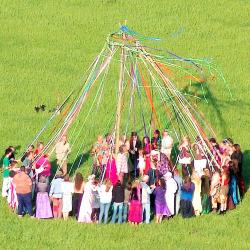
The Order of Bards, Ovates & Druids is a worldwide group of over thirty thousand members in fifty countries, dedicated to practising, teaching, and developing Druidry as a valuable and inspiring spirituality.
The Order was founded in Britain over 50 years ago by the historian and poet Ross Nichols, aided by the writer and founder of the Tolkien Society Vera Chapman, and fellow members of the Ancient Druid Order, which developed during the early years of the last century out of the Druid Revival which began about three hundred years ago.
The Order is organised as a not-for-profit Community Interest Company focused on teaching Druidry, promoting environmental awareness and tree-planting, and on fostering Druid culture, history and related folklore and mythology and the Bardic arts of storytelling, poetry, music, and the performing arts. At its heart it is a Mystery School and a community, and the term ‘order’ is derived from the tradition of magical orders rather than from the tradition of religious orders. Neither the Order nor Druidry is a cult. A cult revolves around a personality, a charismatic leader, or a particular deity or saint. The Order and Druidry have none of these characteristics.
The Feminine principle is considered as important as the Masculine principle, as are principles that transcend gender, and all are celebrated and represented in the Order’s teachings and membership. The Order is not patriarchal or biased in favour of men – many women are in leadership roles and over half the membership is female.
Membership of the Order is open to followers of all faiths and none, regardless of gender, sexual orientation or ethnic origin. This statement reflects the values we consider central to our philosophy: of tolerance and inclusiveness that completely rejects expressions of racism, sexism, and homophobia. The Order has always stood for and continues to stand for equality and freedom for all, and so stands shoulder to shoulder in solidarity with those seeking equal civil rights for all. The Druid’s Prayer inspires the knowledge & love of justice and the love of all existences, and the Order is a community that celebrates life in all its beauty and diversity, that seeks to protect and preserve the Earth, and that focuses on teaching Druid spirituality for the times we live in – emphasizing the virtues of compassion and respect for all of life.
Although most members practise Druidry on their own, there are over 300 groups around the world that offer the opportunity for members to meet and celebrate together. In addition, individual members and groups organise gatherings, retreats, camps, conferences and workshops. See the Get Involved section on this website for more information.
EVERYTHING YOU NEED TO KNOW ABOUT SAMHAIN
Learn more about Druidry and how to join the order
The practice of Druidry used to be confined to those who could learn from a Druid in person. But now you can take an experience-based course wherever you live, and when you enrol on this course, you join the Order of Bards, Ovates & Druids, and begin an adventure that thousands of people all over the world have taken. It works with the ideas and practices of Druidry in a thoroughly practical, yet also deeply spiritual way.
The Order offers comprehensive training in Druidry in six languages through its distance learning course, which includes a personal mentorship programme, camps and gatherings in many countries, a monthly magazine, and members’ internet forums. In addition, the Order promotes a Sacred Grove Planting Programme and a Campaign for Ecological Responsibility, and supports four tree-planting charities: Children’s Forest, Trees for Life, Tree Aid, and The Woodland Trust.
The Order also offers training in celebrancy (the art of leading weddings and funerals and other rites of passage), and educational materials in the form of books, audios, retreats and workshops to people who are interested in the Druid tradition and would like to incorporate some of its ideas into their lives, as well as to those who would like to follow a training programme in Druidry.
FAQ About Druidry & the Order
We see the aims of Druidry and the Order as helping us experience and express Love, Wisdom and Creativity. Creativity – in opening us to our full potential: for bringing beauty into the world, for discovering the stories deep within us, and the stories that can be found in each and every person, and in the world of Nature. Wisdom – in the old myths and legends, in the Welsh & Irish triads, and in the centuries of scholarship to be found in the Druid tradition. Love – in the love of trees and stones, the love of animals and the body, the love of story and myth, the love of beauty and peace, the love of each other and the love of life.
No – all members are encouraged to believe and practice only those things which they feel are true and right for themselves. There is no dogma in Druidry, which instead is characterised by the qualities of tolerance and an appreciation of diversity. For this reason people with widely differing approaches are members, from Pagans and Wiccans to Christians and Buddhists, and to those with no particular philosophy or religion.
There are, however, a few beliefs which most members probably hold in common:
In Spirit, or God/dess – in something more than just matter
In the Otherworld – in something more than just the world of appearances
In Rebirth – in life after death in some form
In the Web of Life – in the interconnectedness of all life
In the Law of the Harvest – in the law of cause and effect, that we harvest the result of what we have sown.
And, above all, in the sacredness of Nature and of Life, and that we should work to preserve and protect the Natural world, helping to restore its diversity and eliminate pollution and environmental destruction.
No! Anyone can follow the Druid path, regardless of ethnic origins, gender, or sexual orientation. Over 200 million people in Europe, America and Australasia can trace their ancestry to the Celtic lands. The tribes called Celtic by the Greeks and Romans were so varied and intermingled so much, Celtic scholar Dr Anne Ross concludes that the Celts are the ancestors of most modern Europeans, and therefore of most people of European origin. In addition, many people of Afro-Caribbean origin have Celtic ancestry too, since Oliver Cromwell sent many ‘slaves’ (indentured servants) to the Caribbean, and they intermarried with descendants of slaves of African origin.
If, like the ancient Druids, you believe in reincarnation, then our genetic ancestry is only one strand of our inheritance. Whatever our ethnic origins in this lifetime, we will have had other origins in other lives. And in the final analysis, we are all members of just one race: humanity. Druidry celebrates our humanity, and is not restricted to just one ethnic or cultural group.
Yes! Many members are Wiccan, and find Druidry a powerful and valuable complement to their path.
See the special section on this website: Wicca & DruidCraft
Yes, they have much in common: sacred circles, the honouring of the directions, a deep reverence for the natural world, a belief in animal guides, and an abiding sense that the land itself is sacred. There is even evidence that the Druids worked in sweat-lodges and we know that birds’ feathers were used in ceremonial clothing and headdress. Some Native American teachers express the opinion that “white people” are taking their traditions from them, just as they have taken their land. “They should make connection with their own roots first,” they have told us. “Then they can come to us if they like, but first let them make peace with their own ancestors.”
While being wary of generalizing, because there are always exceptions, we believe they are probably right. Once we can feel fully at home in our own indigenous tradition, then somehow it is easier for us to relate to other traditions. Coming from a secure, rooted base we no longer have the feel of an outsider or a predator, and we can transcend the divisions of race and culture to feel truly at home in all traditions, with all of humanity.
Very much so – and this is discussed in the Bardic course. Members are free to conceive of Deity in their own way.
All kinds! About half are female, half male. We have teenagers and retired people following the course. Because it is experiential, it can be followed whether you left school at 16 or whether you have a doctorate. We have teachers and carpenters, farmers and shopkeepers, musicians and artists, doctors, lawyers, college professors, priests, Pagans, Wiccans, Christians and Buddhists, all enjoying the training programme.
Over 25,000 people have joined since the distance learning programme was started in 1988. At any one time about 2000 people across the world are studying the course. They come from all walks of life and many different countries, including Britain, Ireland, France, Germany, Italy, Spain, Belgium, Holland, Sweden, Finland, The United States, Japan, Indonesia, Australia, New Zealand, Malaysia, South Africa, Hungary, Bulgaria, Mexico, Brazil, Israel and Poland.
Although we know that in Druidry was influenced by Freemasonry in the 18th and 19th centuries – a period not noted for its belief in the equality of the sexes – and consequently in those times it tended to be male-dominated. But this no longer applies in modern Druidry. History records that in ancient times Druids were both male and female, and in the Order membership is divided almost equally between women and men, with there probably now being more women than men in the Order. Women and men are equally involved in the administration and direction of the Order, and we also have a flourishing LGBTQIA community.
Although the Order’s training programme is sometimes described as a ‘correspondence course’ this is not an accurate description of the training programme which works primarily with your experience, and does not require essays, exams or tests in the conventional sense. Instead the course works as ‘home learning’ or ‘distance learning’, and in its audio format we have tried to create a contemporary version of training in what was originally an oral tradition. You can read more about this way of learning Druidry, and listen to sample audio clips here.
Yes! Michael Harner, a world authority on shamanism, speaks of the shamanic way as one which is best defined as a method to open a door and enter a different reality. Much Druid ceremony and meditation has as its goal journeying into other realities, and the word ‘Druid’ is related to words meaning both ‘oak’ and ‘door’ – with the symbol of the door or gateway being central in Druidic teaching.
We can find many shamanic elements woven into the philosophy and practice of Druidry, and in summary we can say that some elements of Druidry are certainly shamanic, but Druidry is not exclusively so – it has alchemical, magical, and philosophical dimensions too.
Members who would like to contribute to the work and aims of the Order are most welcome. As examples: musicians in the Order have created compilation albums of their work, poets in the Order have done likewise. Members help to run magazines in various languages, and they organize or help with camps, assemblies and workshops, the mentoring system, the website. Members contribute to the Order Archives and to the teaching programme, they work as hospital or prison chaplains and as celebrants. If you have an idea or suggestion let us know!
Most of our problems, both individual and social, seem to come from our sense of alienation, of being disconnected: from Nature, from our hearts, from our Selves, from others, from Spirit. Joining the Order helps us re-build these connections, or re-member them. By celebrating the seasonal festivals and working with the sacred plants and animals of Druid tradition, we get closer in touch with the natural world. By working with the experiential exercises in the course and on retreats, workshops and camps we open up to our hearts and the hearts of others. And as we connect and network across the world with others of like mind and feeling, we come to experience a real sense of community, which touches us even deeper when we actually meet in the physical world.
A Seed Group can be formed by any member at any point in their studies. Each group is different, but they are designed to be informal and relaxed – giving members the opportunity to meet and meditate together, and to discuss the course, their studies, and topics of mutual interest. Many groups celebrate the seasonal festivals together, and to attend a Seed Group you do not necessarily need to be a member of the Order.
A Grove is a group that meets regularly and is led by at least two members who are in the Druid Grade. A fully functioning Grove will celebrate the eight festivals, give initiations, and may also hold Groves in each of the three grades.
We received this email one day. Our reply follows. “Why should I take your course when I can get lots of information from a book? I respect your organisation and the time and effort you have put forth to develop a training program. However, I firmly believe you cannot charge a fee for religion. If you were offering an educational degree recognised in college or university, that, of course, would be a different story. As it is, I disagree with your methods, if not your motives. Best of luck to you in any case. May the Lord and Lady be with you.”
We replied: “Many thanks for your message. We respect your point of view, but would just like to mention some points you may not have considered: you say you can get the same information for less in book format, but the whole point of the course is that it is not just about information – you become a member of a worldwide community who meet, sometimes physically at workshops, retreats and camps, sometimes through the social networking, or through the Order’s journals, and hopefully sometimes in the Inner World too.
The course is experiential more than informational, and can take you on an experiential journey that a book cannot. Being in dialogue with a mentor is also something that a book cannot provide. So, although a book can provide information, it cannot provide you with these relationships: with an Order, with a spiritual community, with a mentor. The course guides you on a journey in an interactive and growing way over a period of time – again, a book cannot do this.
It would be great if all this could be provided for free, but the world isn’t like that and all these things cost money to set up and maintain. Each year, for example, students receive over 52 lessons, together with audios and a monthly copy of the magazine Touchstone. So in terms of value for money, we do not feel that the course is too expensive for what is provided. While I understand that many people feel that money and spirituality are incompatible, this is really an idea that comes from a dualistic approach to life which tends to put money, dirt, evil, the Earth, the body, sex, matter and the Feminine on one side of the fence, and Spirit, mind, purity and good on the other side. We have to spend money on paper, printing, mailing, offices, computers and staff, and that money has to come from somewhere. We feel that the monthly cost of the course is not a lot to spend in return for all that you receive, and it is probably far less than many people would spend on a movie or a good book!”
Certainly we make a mistake if we consider one grade superior, or even totally separate from the others, but there is a profound value in having these separations, which are more accurately described as specialisations.
Each of the grades awakens or resonates with a particular aspect of the soul, which is quite unique and distinct. The Bardic grade is designed to help us awaken to our inherent creativity – to stimulate those aspects of our soul that long to express themselves in the world. You could say that the purpose of the Bardic grade is to help us sing the song of our soul. This is to be taken in its widest sense; for some of us it may literally help us to sing out, while for others it may help us to express ourselves creatively in other ways.
The Ovate grade’s purpose and design is to help us awaken to the inner ‘Wild Person’ – to ignite the ‘green fire’ in our souls that feels at one with the spirit of all Nature. This inner ‘wild person’ can be seen as the ‘inner shaman’ or ‘inner healer’ too, who is able to unite instinct with intuition.
The Druid grade’s purpose and design is to help us awaken to the inner Sage – that wise person who exists in each of us – who is sometimes only heard as a ‘still small voice’ offering counsel, but is often not heard or heeded at all.
By understanding the grades in this way, we can see how the Bardic grade is opening us to our hearts, to our feelings, upon which our creativity depends; the Ovate grade is awakening us to our bodies and our instincts (which is why we work with our ancestry and with healing in this grade); and the Druid grade is awakening us to the deeper powers of our mind.
Just as the body, heart and mind form a triad which makes up the human being, so the Bardic, Ovate and Druid grades form a triad which makes up the path or spiritual way of Druidry.
It is often useful to separate work on the human being into these three parts, to focus specifically on the body, the emotions or the intellect, but in reality the human being is one. Likewise with Druidry and with membership in the Order: it is helpful to work within these three schools of learning, but in essence we are all simply followers of the Druid Way, coming together within the fellowship of the Order to learn, and to love.
Have a look at this page which has more FAQs, and if you still have a question drop us an email at office@druidry.org and we’ll be happy to answer your question!